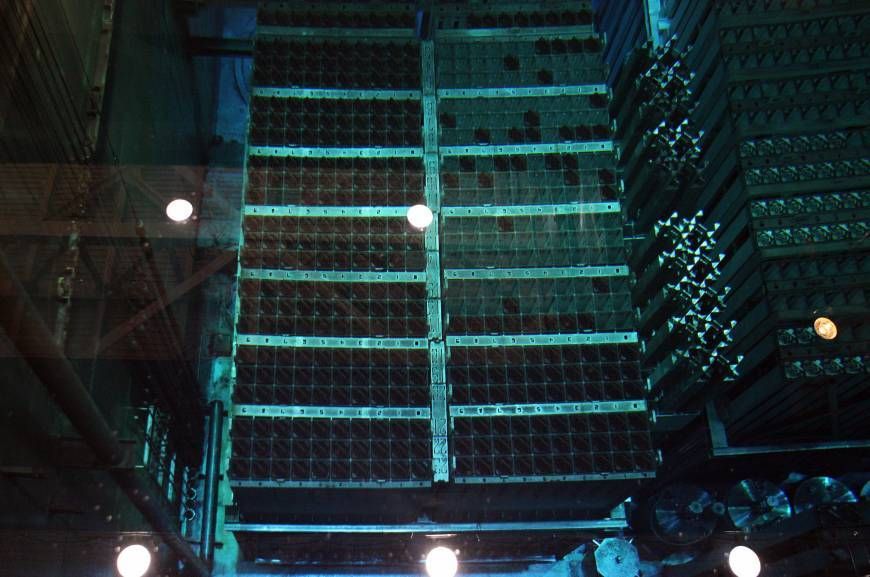
Channel boxes containing fuel rods with plutonium-uranium mixed oxide (MOX) lie in a pool in the building housing the No. 3 reactor at Tokyo Electric Power Co.'s Fukushima No. 1 nuclear power station in the town of Okuma in August 2010. | BLOOMBERG
Five nuclear plant operators have spent at least ¥99.4 billion on imports of plutonium-containing mixed oxide (MOX) fuel since it was first shipped to Japan in 1999, Jiji Press learned on Saturday.
Some of the imports cost nine times more than conventional uranium fuel.
The MOX fuel, a mixture of plutonium extracted from spent nuclear fuel and uranium, is a core component of Japan’s nuclear fuel cycle. But the use of the fuel has drawn criticism for its high costs.
Japanese power companies that use or plan to use the MOX fuel commission the fuel’s production from companies in France and elsewhere.
The five that imported MOX fuel are Tokyo Electric Power Co., Chubu Electric Power Co., Kansai Electric Power Co., Shikoku Electric Power Co. and Kyushu Electric Power Co., according to the Federation of Electric Power Companies of Japan.
Of the five, Kansai Electric, Shikoku Electric and Kyushu Electric have revised their monthly power rates to reflect the cost of using MOX fuel.
Since 1999, MOX fuel has been shipped to six of the five companies’ nuclear power stations. Trade statistics compiled by the Finance Ministry and other data show that the imports since that time have totaled ¥99.437 billion, including the costs of transportation and insurance.
In June 2013, Kansai Electric imported 20 units of MOX fuel assemblies from France for ¥18.514 billion for use at the No. 3 and No. 4 reactors at the Takahama power station in Fukui Prefecture.
The average cost per unit stood at ¥925 million, compared with the average of around ¥103 million for 60 units of conventional uranium fuel that Kansai Electric imported from the United States between October and November that year, also for use at the two reactors.
All five power companies declined to disclose MOX fuel costs, citing confidentiality of MOX fuel procurement contracts.
Japanese power companies use MOX fuel by mixing it with conventional uranium fuel. The share of the MOX fuel in the total fuel used has been limited to around 30 percent so far. The Oma nuclear power station of the Electric Power Development Co. (J-Power), which is under construction, will be the first one that will rely entirely on MOX fuel.
The use of MOX fuel in Japan is being halted because all commercial reactors still remain idle nearly four years after the nuclear disaster at Tepco’s Fukushima No. 1 power station began in March 2011. The federation planned to have MOX fuel used at 16 to 18 reactors across Japan by fiscal 2015, but the plan was put off.